When a team moves from asking an AI to do one task at a time to an always-on agent that keeps a goal, the first decision is not the model name. It is what a human must approve, when the agent should stay silent, and what must be recorded. Approval points, permissions, and audit lines differ by system and by workflow.
What is being offered (provider descriptions)
On November 17, 2026, Cognition announced Devin Bots (announcement, checked 2026-11-18). According to the provider, a Bot is a persistent agent with its own memory and tools. It can lead multiple Devin sessions, evaluate results to decide what to do next, and bring a person only the decisions that need human judgment. The product is presented at devin.ai/bots. The pricing page checked the same day lists access to Devin Bots on the individual Max plan ($200 per month), the Teams plan, and Enterprise. That is the provider's published wording, not a recommendation of any plan. Whether a given Japanese account can use the product, and whether a Japanese-language interface is available, is unverified (未確認).
The same announcement says, in Cognition's own words, that the company as a whole (not only its Bots) merges "more than 2,000 PRs a week." The page also carries a customer testimonial from Will Laughlin, VP Engineering at Bilt (shown with the Bilt logo), saying that "our Devin Bots merged about 1,600 PRs" the previous week. These are a company claim and a customer quote that the provider chose to publish. They have not been independently verified, and they are not a guarantee of results.
Whether to put an always-on agent into production is not settled by announcement figures. What has to be decided first is where humans judge, when the agent stays silent, and what is written down.
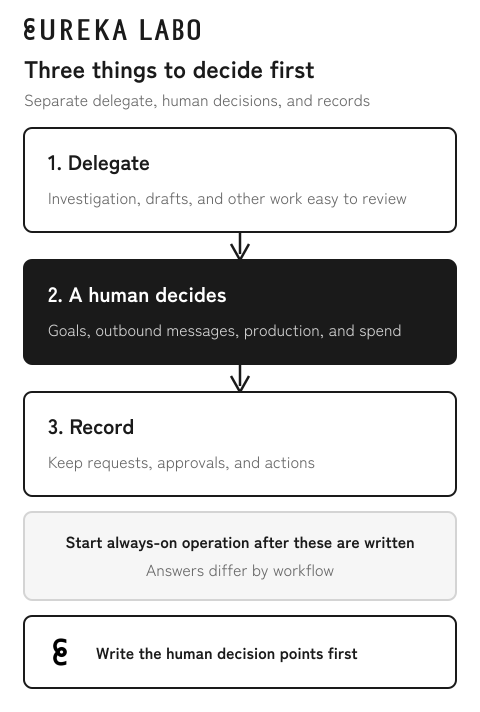
Decide three things first: what to delegate, what a human decides, and what to record
Before an agent is left running, write down these three distinctions. The answers differ by workflow.
- What may be delegated. Work that is easy to review later, such as investigation, lists, drafts, and checks in a test environment.
- What a human must decide. Changes to the goal, messages sent outside the company, production releases, spending caps, and any widening of permissions.
- What must be recorded. What was requested, what was approved, and what was executed. If a task cannot be traced later, it is not a candidate for an always-on agent.
An earlier article, "Three Decisions Before Adding AI to an Existing System," covers what to decide before connecting AI: the data you pass, the actions you allow, and how you will find mistakes and roll them back. This article is about the next stage — when an agent will stay on and hold a goal — and about fixing the points a human must see. It extends the earlier rule that automatic execution waits until a rollback path has been tried.
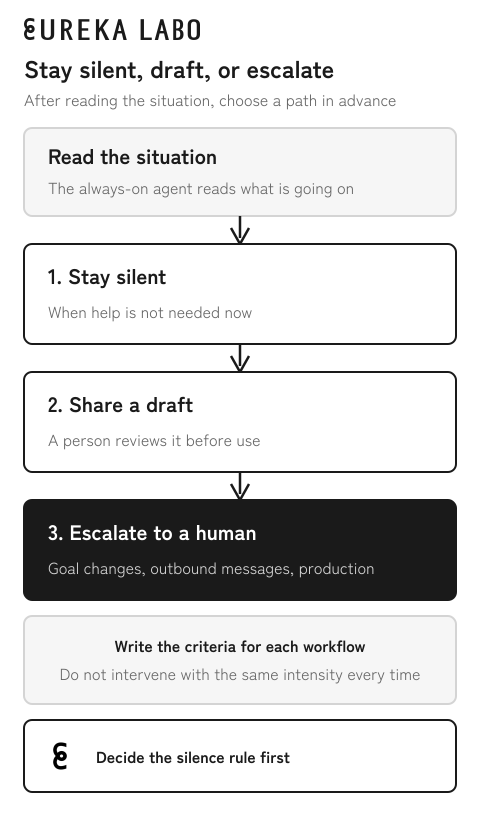
Stay silent, share a draft, or escalate to a human
An always-on agent should not intervene with the same intensity every time. After it reads the situation, it needs a pre-agreed branch: stay silent, share a draft, or escalate to a human.
Knowing when to stay silent when help is not needed is also treated as a hard point in a third-party benchmark. Deepnote's Agent Initiative Benchmark v1.0 (research page, GitHub, checked 2026-11-18; the page carries no date; the GitHub repository was created on 2026-11-09 (JST), and results were pushed on 2026-11-13) places an agent in the Slack of a synthetic company, PageMantle, and reports results for 12 models on the same 50 workplace situations at a high effort setting. The score is the mean of two LLM evaluators, on a 0-to-10 scale. On Deepnote's page, a message went out 9 times out of 10 when help was needed, but a message was held back only 6 times out of 10 when silence was right (only 10 of the 50 tasks called for silence). The page also says the most expensive models were not the best, and that the two heaviest tool users scored lowest (more tool calls did not buy a higher score). Published mean cost per task ranges from $0.007 (GPT-6 Luna) to $3.02 (Claude Fable 5.1), depending on the model.
These are Deepnote's published results, not measurements by Eureka Labo. The page lists its own limits: a 50-task panel, a single high effort level, a fixed snapshot of company data, and replies only through Slack. Scoring is also done by LLM judges. In addition, and this is our note rather than Deepnote's, the synthetic company and its tasks are in English, so Japanese-language workplaces are not covered. Deepnote is not a model vendor, but it does offer a commercial product. The same numbers will not necessarily appear in another workplace. Even so, the design point can be checked on your own systems: if the rules for staying silent and for escalating are not written first, an always-on agent can help too often.
A checklist before an agent stays on
This table lists what to check. It does not recommend a product or a setup.
If the table does not fit, scroll it sideways.
| What to decide | Examples to write down first | What to verify yourself |
|---|---|---|
| Scope to delegate | Investigation, drafts, and checks in a test environment, for example | The systems you connect, the types of data, how easy a rollback is |
| Points a human must decide | Goal changes, outbound messages, production releases, spending caps, wider permissions | Who approves, and whether work stops when approval is missing |
| When to stay silent or intervene | Do not post in a thread that is already settled; keep drafts and production apart | How unnecessary interventions will be found. Do not copy third-party benchmark numbers into your own rules |
| Records | Requests, approvals, actions, and permissions used | Whether a single case can be traced later |
| Provider terms | The plan and price on the path you would use (for example, the pricing page lists Devin Bots on Max, Teams, and Enterprise, checked 2026-11-18) | Availability in Japan, the contract, and how data is handled (do not start on an item that remains unverified) |
How this relates to the harness around the model
What to inspect around the model when results are unstable is covered in "The Harness Around the Model Matters as Much as the Model": instructions, the information you pass, the tools the model may use, how you check results, and records. Those five parts still matter for an always-on agent. What this article adds is that the points a human must decide, and the branch between staying silent, drafting, and escalating, should be written as operating rules first. Inspecting the parts and designing the permissions are not the same task.
When to bring in outside help
In cases like the following, it can be reasonable to bring in an outside developer rather than handling everything internally.
- Human decision points cannot be written down because several systems and permission models are involved.
- The team wants an agent closer to outbound messages or production releases, but there is no way to stop work or to record what happened.
- The rules for staying silent or intervening cannot be fitted to the current workflow.
Eureka Labo provides software development, from contract development through FDE (forward-deployed engineering), and AI consulting. To talk about building approval points, permissions, and records for an always-on agent, describe the current setup and the problem, without including confidential information. After the details are reviewed, Eureka Labo will discuss the scope of help.
Official sources checked (fetched 2026-11-18 JST)
- Cognition, "Introducing Devin Bots: from tasks to outcomes" (2026-11-17), https://devin.ai/blog/introducing-devin-bots
- Devin Plans and Pricing, https://devin.ai/pricing
- Deepnote, "Agent Initiative Benchmark" (v1.0), https://deepnote.com/research/benchmark
- GitHub, deepnote/agent-initiative-benchmark, https://github.com/deepnote/agent-initiative-benchmark